First, thanks for Brad for guest blogging. I'll respond to some of his posts soon. But I'm at the internet, and I have some things to add.
This week was busy. It's my second week of teaching a night course at my organization. I really enjoy "Business English" but its tough to finish the day at 8:30 to 9:00 four days a week. This week was made even longer by the fact that it was our Spring Week of Kindness. Traditionally, we do tons of volunteer events during this week. And we did, but just on a smaller scale than usual. I really wish I could get more focus on our volunteer activites. They were doing so good two months ago, but then they have fallen apart again. But yeah, I was at work every day around 9 or 9:30 and going until 8:30ish. Long days for me. But good days. For the most parts.
Other news, I saw the group Bi 2 live last night. Apparently they are one of the coolest Russian rock bands ever. http://en.wikipedia.org/wiki/Bi-2 They played for two hours, which I was impressed with. And the setting of Navigator (still the best club in town - www.navigatortaraz.kz/ although web site is usually down) is great for rock concerts. Or has potential to be. I don't understand how some people can chill out in the VIP sections just eating and talking while there is a rock concert going on. But Bi 2 was great.
Soon, I'll be posting a heroic story of when I entered a hot dog eating contest a couple weeks ago. Hopefully that will start Monday. Happy belated Earth Day to all!
Friday, April 23, 2010


Sunday, April 18, 2010
Day Six: Astana (guest blog)
This is my last guest blog post for "The Adventures of Hotard." It's a day late, but given that my final day in Kazakhstan also included a 32 hour travel period, I feel justified. I was flying over the Atlantic two weeks ago.
We finally arrived in Astana after a seemingly endless train adventure. I spent the evening and night sleeping with fish, wandering the train, hanging my head out the window, and smiling at people I couldn't understand. Michael slept like a baby.
When we reached Astana, Michael's Kazakh friend Berik was waiting to meet us. He graciously offered to spend the day with us and let us crash/store stuff at his place. He lived in a wonderfully quirky apartment in a very Soviet apartment building near the city center.
Immediately after dropping off our stuff, we visited a grocery store and then made breakfast. It was another chance for me to try disgusting traditional beverages of Kazakhstan. (The previous beverages experiences didn't make the blog, but they included fermented cow's milk and many cheap vodkas.) Up for taste test this morning was fermented horse milk and Kvas, neither of which I can really describe. Like all other traditional drinks in Kazakhstan, they are very sour.
We had a full day of sightseeing ahead of us, so we wasted little time. First on our list was the Palace of Peace and Reconciliation, which is a pyramid.

Before I continue, I must explain a bit about Astana and the history of Kazakhstan. Wikipedia explains this more thoroughly, but here goes. In the 19th century, Kazakhstan was inhabited by nomadic herders. Then the USSR happened and suddenly Russians and all kinds of other ethnic groups were being resettled by a centralized government that had a big agenda and little information about its newly incorporated territory. Because Kazakhs were nomads, there were very few cities and, to the USSR, the country looked empty. So they started resettling people there. Gradually, a largely "Soviet" culture developed in Kazakhstan, which was at conflict with the values of 19th century nomads.
Then, suddenly, in 1991, Kazakhstan became an independent country. They were independent for the first time since the turn of the century, and the world was very different now. That being said, Kazakh identity was very important for ethnic Kazakhs living in Kazakhstan. In part, this ethnic identity led to rifts between Kazakhs and Russians living in Kazakhstan. Since 1991, Kazakhstan has sought to distance itself from Russian culture and assert its own national identity. However, this identity is largely derived from a totally different place and time.
Astana is part of this redefinition of culture. Before becoming the capital in 1994, Astana was a tiny place in the vast northern steppe. Suddenly massive government investment was focused on creating a Kazakh city to serve as a center of national identity. Monuments were erected. Wildly bizarre architecture was commissioned. Buses with plasma TVs and strict schedules were instituted.
In the end, this new Kazakh culture succeeds in being "not Russian," but in many ways it is also "not Kazakh." Translating 19th century nomadic Kazakh culture into 21st century post-Soviet culture is a work in progress, and more art than science.
Back to Astana- and the Palace of Peace and Reconciliation. The building is full of symbolism, from the height to the number of floors to the colors of the walls to the stones used in the walkways. Doves are painted on the top floor. The first floor is the "underworld." The building holds periodic summits of all world religions, seeking to facilitate cross-cultural dialogue. Our tour guide acted like a robot- his mannerisms were incredible as he delivered various lessons in Kazakh history and the vision of President Nazarbayev for the monuments of Astana. The pyramid was a funny experience.
Then it was time for Bayterek, the most famous monument of Astana.

You'll notice a tower in the center of the picture with a golden egg on top. That's Bayterek. It's supposed to be a poplar tree. On top of Bayterek, there is a large golden egg (which you can visit via elevator - and I did). There is another monument with a golden bird on top. This golden bird laid this golden eggs.
I could go on and on about architecture and symbolism in Astana, but it's better if you experience it for yourself. The last 20 or so pictures in my Kazakhstan photo album capture just a small part of this identity-defining architecture prevalent throughout Astana.
The rest of the day, I kicked around the city with Michael and Berik. We later met up with Ken, another PCV, for dinner and dancing at this high-fashion restaurant called Fusion. Fusion cracked me up, mainly because it was part American steakhouse, part sushi bar, and 100% ridiculous Americana. There was a Harley-Davidson under spotlights by the hostess table and picture of George Washington on the wall.
It made for a wonderful final evening in Kazakhstan. Kazakh food, good music, old and new friends. There was a house singer who performed glorified karaoke all night with classic American tunes popular in Kazakhstan, which are few in number and not particularly popular in the US.
I left around 2am to head to the airport and begin my journey home. There is more to the story, but I'm actually traveling again right now and need to leave for the airport to begin my journey home once again, and so I must truncate my blog post. Please check out the photos, and stay tuned while we return to your regularly scheduled blogger.
-Brad Lindell
Friday, April 16, 2010
Day Five: The train to Astana (guest blog)
Friday morning I said my goodbyes to Acela and the city of Taraz to embark on the last leg of my journey - a 21 hour train ride to the Kazakh capital of Astana. The long haul from southern Kazakhstan to the middle of Siberia was an odd choice for my final day in Kazakhstan, but I really felt that it was important to visit the capital if I wanted to understand Kazakhstan post-independence from the USSR.
The other perk of a visit to Astana was a long-haul train ride on Soviet rails in a Soviet train. I've always had a dream of traveling the length of the trans-Siberian railroad from Moscow to Vladivostok, and I decided that 21 hours to Astana would be a good "trial run" of my ultimate train adventure.
You may remember that my original Kazakh train trip from Almaty to Taraz was in the luxurious 4-bunk-per-room Chinese train. Now on my fifth day in country, it was time for a "real" Kazakh train experience: platscart. Instead of sleeping in a room with built-in bunk beds and a door, I was now traveling in a train car packed floor-to-ceiling with beds and Kazakh families. Six beds now occupied the space of four. There were no doors, no hallway, just beds and spaces between beds almost large enough for you to stand up in. Pictures really explain it better than I ever could.

The train was full, cramped, and blazingly hot. It was also a place where bizarre things seemed to happen with no explanation nearly all the time.
Michael and I had a set of bunk beds, and the other bunks near us were occupied by a young family traveling with a six month old boy. Shortly after we departed Taraz, the entire family took turns changing out of their street clothes and into "train clothes," which Michael explained was normal and to be expected for such a long trip. Then the family had lunch together. Inexplicably, they had packed full, elaborate meals of chicken, bread, and endless side dishes. Entire bags I had assumed to be full of luggage were stuffed like sophisticated picnic baskets. There were drinks, there was vodka, there was Raxhat candy. Once they finished eating there were snacks. Then came another meal.
Food also abounded at the various stops that the train made throughout the night. Michael explained that each stop was "famous" for a certain type of food. Sometimes it was fruit or bread, sometimes kebabs, sometimes I couldn't even start to figure out. Then we reached the smoked fish stop.
I would have taken a picture but it was the middle of the night and the sight of fish was already too much for me to bear. Women entered the train cars holding dozens of smoked fish strung up by the gills. The fish were huge (easily 24 inches) and completely disgusting. They were brown and looked half-preserved, half-dried in the sun for weeks. They were fat and flat and people were buying them with reckless abandon. The family sharing our bunk area bought four or five, much to my disappointment. Michael later asked and they said they always brought them to relatives in Astana. It seems the smoked fish are a sensation throughout the country. This fascination with fish is particularly bizarre because Kazakhstan is about as landlocked as a country could possibly be.
After buying the fish, the family folded the fish in half (cue the cracking noise of fish scales and bones) and stuffed them in a bag. If that wasn't bad enough, they stuck the bag of folded fish on the luggage rack about four feet from my head. That's when I knew it would be a real Kazakh platscart experience.
By this point, it was dark outside, I was hot, and the fish were smelly. Michael wanted to take a nap and I decided to escape in search for fresh air. I found respite next to an open window at the back of the train car next to the bathroom. This location was both a blessing and a curse. A blessing because the window existed, but a curse because the combination of terrible bathroom facilities and a constantly rocking train care meant that the smell of bathroom pervaded the area.
I coped by hanging my head out the window and looking out over the steppe. The near-full moon and near-empty landscape were a welcome change from the relative chaos of the train.
Thursday, April 15, 2010
Day Four: The Talas River (guest blog)

Several things happened today that I will not be writing about. Specifically, I had a wonderful Dungan lunch, a delicious Russian dinner, visited several important monuments in Taraz, and spent several hours at a techno dance club that had no power and was operating by candlelight. Each of those could warrant a blog post, but today I only have time for one topic: tubing.
It all started at Tektor Mas, a monument outside of Taraz that sits on a stately hill overlooking the Talas River. We visited Tektor Mas because it's one of those "must-do's" that people with books like Lonely Planet and Rough Guide tramp around the city looking for and taking pictures of. I do a fair amount of traditional tourism, and so I wanted to check it out, too.
We stood behind the monument overlooking a lazy bend in the river, catching up on life and enjoying the breeze and sunny weather. Today was the best day weather-wise I had in Kazakhstan. It was in the upper 60s and really quite comfortable, even with the wind. We scampered down the hill to the water to follow a path that we spotted.
For whatever reason, as we walked along the river for a few minutes, I really felt compelled to go tubing. Michael had never been tubing, so we talked through the logistics. Ideally, you need a fast-moving, relatively calm river, a bunch of buddies, and a cooler full of beer. (The beer is optional, but encouraged.) To my surprise, Michael got excited.
I have a history of bad ideas, especially when it comes to water sports. I was planning on Michael being my voice of reason speaking out against this terrible idea. Instead, I think he embraced the spontaneous in favor of more sightseeing. The next thing I knew, he was calling Kazakh people.
There were many immediate questions: Where does the river go? Is it safe? Do people do this? Where can we find large inner tubes? How much do they cost? Does anyone else want to go? Is it illegal? What's the worst that can happen?
We ended up heading to Michael's office to discuss with Acela and the others we found there. We needed a map, and some information. From there, with a strong warning from all Michael's colleagues, we were off to the bazaar. Soon enough we learned the word for inner tube (camara), then used hand gestures to find the large truck and tractor tire section of the bazaar. Soon we were the proud owners of two inner tubes and some rope. A quick trip to a mechanic and the tubes were inflated.
Back at Michael's apartment, we tied the rope haphazardly across the tubes to fashion a "bottom," which was designed to protect our butts and give us something to grab if we fell out and/or were swept away in a current. Next thing I knew, I was wearing spandex and hailing a taxi.
We put in just past the railroad bridge. In our preliminary scouting, we realized that this particular bridge was patrolled by angry appearing men sporting long rifles. It seemed prudent to avoid their line of sight.
Once on the water, things went remarkably well. The water was freezing, as the Talas River is fed by snow melt from the scenic mountains in Kyrgyzstan. But overall there were few obstacles to avoid.
We tackled two waterfalls (1 on purpose, 1 quite by accident as I was unable to stop) and avoided one which would have likely capsized the inner tubes. We floated past fishermen, farmers, and children playing on the banks and bridges. I waved at everyone, even though Michael said that Kazakh people don't wave. I think it made many people uncomfortable, but then again it could have been the fact that I was floating by in an inner tube on a snow melt river.
We took out after about an hour float, at an overpass that we had spotted on the map back at Michael's house. Sure enough, there was a bus stop nearby, and we had nearly drip dried when we got picked up for the ride home.
In the bus, we were quite a source of entertainment. I don't think Americans armed with inner tubes and still quite damp have ridden on a bus in Kazakhstan before. The adventure ended with a 15 minute walk through downtown Taraz with tubes in tow.
We had done the impossible - floated a river despite everyone telling us it was a terrible idea and that we would die. We had braved the freezing water to chase our dreams, or something like that. It was awesome.
Wednesday, April 14, 2010
Day Three: Asa (guest blog)
I would be lying if I said that I got a great night's sleep in the yurt. It was cold and the beds were pretty primitive. That being said, I had only been in Kazakhstan for two nights, and I had yet to sleep in a real bed, so I had no trouble getting some rest. I woke up in the morning to roosters crowing and watched my breath condensing in a tiny shaft of light coming through the woven panels of the yurt's outer shell. I felt pretty Kazakh.

Asa is a small town with one main paved road and a full spectrum of housing- from Soviet apartment blocks to single family homes and even some pretty primitive dwellings on the outskirts of town. It's a very pleasant place to be, and a place where it's much easier to feel connected to the roots of the country and its people. Cities like Almaty and Taraz have certain unique attributes, but in the end they are much more akin to American or European cities than to villages like Asa.
You will note in the above picture that two basic utilities are funneled into the homes of all Asa residents. The power lines should look familiar. But the bright yellow pipe suspended six feet above the ground and engineered to soar high above driveways and intersections is probably pretty foreign to you. It certainly was to me. I've heard two theories for the content of this pipe, though no one could tell me for certain in Asa. It either carries steam or natural gas, and either way it functions to provide heat for homes in the winter. As best I can tell, this practice of piping "heat" into peoples' homes began well before Kazakh independence and continues to this day, though no one really understands how it works.
We left the yurt and walked a few streets over to the home of Salavat, a resident of Asa (and former friend of Dave) who Michael knows well. He greeted us cordially and served us a wonderful breakfast.

This picture captures so many things about meals in Kazakhstan: the table cloths, the way food is served, the fact that bowls are used as tea cups, the constant supply of chocolate candies made by Rahat, the absence of traditional breakfast foods except for fried eggs. I could go on and on about the things on this table and the setting in general, but it's better if you just take some time and examine. Breakfast was delicious.
After breakfast, Salavat offered to let us ride his horses. Salavat's family owns a miniature herd of horses, probably more than a dozen, and they participate in a "cowboy cooperative" of sorts. Each day, one person from the cooperative takes the group's horses outside of Asa to the pastures where they can graze. We would visit these pastures with Salavat and his trusty steed Tony.

Tony was a relatively large, relatively ill-tempered horse who liked to gallop and behave in unpredictable ways. I ended up riding Tony for some time. Here are some highlights:


We rode into the distance - Salavat, Tony, and I. But not so far into the distance that we reached those mountains, which are some 25km away.

At one point, I decided that it would be awesome if Tony would pose with me on some railroad tracks. It seemed like the perfect manly picture. I would be riding a horse, standing firmly in the way of the inhuman force represented by the railroad, a bastion of tradition for hard, grizzled men everywhere. Unfortunately, Tony would not oblige.

I also met a cowboy while out on the range. He was looking after the horse cooperative for the day. He let me hold his whip and pose with his (much smaller) horse. I think it's pretty clear that I have no idea what I'm doing here.
When we returned to town, Salavat invited us to his sister's apartment for beshbarmark, a very traditional Kazakh dish made from homemade noodles, boiled potatoes and carrots, fresh onions, and stewed horse. You eat it with your hands from a communal platter and chase it with funny looking bread.

The food itself was fine, if a bit salty, and eating horse did not give me pause. It was, however, baffling to my hosts that we do not eat horse in the US. I explained that in the US we ride horses instead of eating them, and that horses here are expensive, but I didn't really convince anyone. Funny enough, the day I got home from Kazakhstan, the Tennessee legislature was considering a bill to allow slaughter of horse for meat. The measure was vocally opposed by Willie Nelson.
We left Asa after lunch, and I thought about how many traditional Kazakh things I had been able to do during a 24 hour period: ride in overcrowded minibuses, build a yurt, sleep in a yurt, ride horses on the steppe, and eat beshbarmark with horse meat. It had been action-packed.
That afternoon I went to Michael's English conversation group, where I was the main topic of conversation and I tried to obtain some additional information about my recent Kazakh experiences. I learned that few people in Kazakhstan build yurts, almost no one sleeps in them, and beshbarmark is very popular. It was great to see the kind of work that Michael has been doing recently, and his students spoke very highly of him. A number came up to me after class to tell me that they really only come to English club to hang out with Michael. I told them that's why I had come, too.

English conversation group in Taraz was where I first met Acela, Michael's girlfriend. Having heard so much about her, I was eager to finally meet. We spent some time together before English club, and afterwards she invited me and Michael over to her apartment for dinner. He had to wrap up some work at the office, and so Acela and I headed over to her house to begin preparations.
The plan was to make manti, which is basically a steamed bun made with homemade dough (without yeast) and a meat filling. She rolled out the dough and cut it into pieces, and I was charged with filling the dough and tying the manti into little packages of meat.

When they were all prepared, we steamed them in a funny looking pot.

The dinner was great and reminded me of a Chinese recipe which Karen and I make frequently. I also got to sample several Kazakh beers over dinner, which were largely of the full-bodied lager variety. There are not many IPAs available in Kazakhstan.
After dinner, Michael and Acela tried to teach me a Russian card game called Durak, but I promptly passed out on the floor. My nonstop activities and travel had finally caught up with me, and I caught up on some much needed sleep.
-Brad Lindell
Tuesday, April 13, 2010
Day Two: Taraz (guest blog)
The Chinese train to Taraz is faster and more comfortable than the Soviet train. I have no first-hand knowledge of any other train to Taraz, but by all accounts the Soviet one looks just like the train in Goldeneye. Don't remember? Go blow the dust of your N64 or VHS player and take a gander. Soviet trains would become part of my life near the end of my trip.
We arrived in Taraz early in the morning, before the city was awake, around 24 hours after I landed in Kazakhstan. Exhausted from my day of time travel and an action-packed Almaty itinerary, I was unsure what the day would hold. A cordial taxi driver in a charcoal suit picked us up outside the train station and dropped us in the courtyard of a block of towering Soviet-style apartment buildings. Nothing had ever seemed more foreign, but we were home at last.

We were standing next to an old, broken playground painted in primary colors. Piles of sand obscured see-saws, and odd blue roofs topped unknown structures. The scene was surreal- but bizarrely familiar as if I had seen it in dozens of movies before but never realized that a place like this really existed. We moved toward Michael's building. A dilapidated building with metal windows and iridescent tiles set on a concrete background so imposing it looked like a four-story storm shelter. I had never seen anything like it before.

As I stood outside in this courtyard for the first of many times, I began to realize that Kazakhstan was a very different place than any other that I had visited. There was something very familiar about everything, but it all seemed a bit "off" from what I would expect. I would later go on to identify a number of these characteristics, which may be the essence of this Cold War era concept of the "second world." I will readily admit my ignorance when it comes to Soviet history and the subsequent history of Kazakhstan, but just from my first moments standing in a very typical residential area in Taraz it was easy to feel a "difference."
Michael took a nap and I visited an internet cafe, which provided a first exposure to my complete inability to speak Russian. Very, very few Kazakhs speak English, and those that do did not seem to frequent internet cafes. That morning I only knew two Russian words: internet, and yes. With smiles and hand gestures, that's all I needed to get by.
We spent the morning visiting a few notable sites in Taraz. Foremost among these was the Old Banya Museum- a bizarre collection of 3D relief maps, artifacts, and life-size murals of nomadic Kazakh life all contained within the chambers of a now-defunct 100-year-old banya.

Banyas are public showers and saunas which remain very popular in Kazakhstan. This particular banya fell out of favor, into disarray, and has now been recycled into a semi-public space for science education and cultural discovery. We had a great tour guide who, via Michael's translations, taught me about the history of Taraz, legacy of the USSR, and the social importance of banyas.

After our departure from the Old Banya Museum, we happened upon another apartment complex with another courtyard and another swing set. This swing set was notable for the very traditional Russian metal poles which serve as the swing chains. My reaction to these swings was the same as my reaction to many things in Kazakhstan: initially, I questioned why in the world would someone choose to hang a swing by metal rods? The answer: don't worry about it.
After a delicious lunch of shashlik, we headed to the village of Asa for our most significant activity of the day: building a yurt! For more information on yurts, I recommend that you read all about them on Wikipedia. Ok, now that you know all about yurts, let me tell you our plan and how I found myself building a yurt after being in Kazakhstan for less than 36 hours.

The story of the yurt begins with the story of Dave, a former PCV who lived in the village of Asa. I did not meet Dave, because his term of service ended some time ago. That being said, the legend of Dave has only grown in Asa over time. Dave lived in an apartment above a nice, kind Kazakh family who ran a youth developement program in Asa. He got to know them pretty well during his time in Kazakhstan, and ended up working with their organization extensively.
When he decided to leave Kazakhstan, he acquired a yurt to bring back to America. However, due to unforseen shipping rates, his yurt was far too expensive to transport halfway around the world. And so Dave bequeathed his yurt to the youth organization run by his surrogate host parents. By all accounts, owning a yurt is a source of great pride for Kazakhs, and so Dave's family became the "yurt people" for lack of a better term. When Michael was preparing for my trip, he was quickly referred to the "yurt people" for all yurt-related inquiries.
I will spare you the details, but yurt building is difficult and requires many steps, which are shown generally in the following pictures.


After successfully building the yurt, and now hot and sweaty after hard manual labor and a hard-hitting game of soccer with a bunch of Kazakh men from Asa, it was time to blow of some steam and get clean at the banya.
Michael has already written extensively about the banya experience in Kazakhstan. Here's the quick run-down for banya in Asa:
1) put all of your clothes in a locker
2) hang out with a group of naked men around a single shower head in the corner of a large room meant for relaxation and bathing
3) go to the sauna for a hot, steamy sweat-fest
4) exit the sauna and have someone pour ice-cold water over you
5) repeat steps 3 and 4 ad absurdum
6) beat your partner (or anyone else) with leaf-covered sticks for "exfoliation"
7) take a final shower
8) retrieve your clothes
Michael and I were popular at the banya that night, mainly among middle-aged overweight men who liked drinking beer while they bathed. They even bought us a round of beers, which I viewed as a self-esteem booster I guess? We left soon after, to return to our yurt for a long, chilly night's sleep.
-Brad Lindell
We arrived in Taraz early in the morning, before the city was awake, around 24 hours after I landed in Kazakhstan. Exhausted from my day of time travel and an action-packed Almaty itinerary, I was unsure what the day would hold. A cordial taxi driver in a charcoal suit picked us up outside the train station and dropped us in the courtyard of a block of towering Soviet-style apartment buildings. Nothing had ever seemed more foreign, but we were home at last.

We were standing next to an old, broken playground painted in primary colors. Piles of sand obscured see-saws, and odd blue roofs topped unknown structures. The scene was surreal- but bizarrely familiar as if I had seen it in dozens of movies before but never realized that a place like this really existed. We moved toward Michael's building. A dilapidated building with metal windows and iridescent tiles set on a concrete background so imposing it looked like a four-story storm shelter. I had never seen anything like it before.

As I stood outside in this courtyard for the first of many times, I began to realize that Kazakhstan was a very different place than any other that I had visited. There was something very familiar about everything, but it all seemed a bit "off" from what I would expect. I would later go on to identify a number of these characteristics, which may be the essence of this Cold War era concept of the "second world." I will readily admit my ignorance when it comes to Soviet history and the subsequent history of Kazakhstan, but just from my first moments standing in a very typical residential area in Taraz it was easy to feel a "difference."
Michael took a nap and I visited an internet cafe, which provided a first exposure to my complete inability to speak Russian. Very, very few Kazakhs speak English, and those that do did not seem to frequent internet cafes. That morning I only knew two Russian words: internet, and yes. With smiles and hand gestures, that's all I needed to get by.
We spent the morning visiting a few notable sites in Taraz. Foremost among these was the Old Banya Museum- a bizarre collection of 3D relief maps, artifacts, and life-size murals of nomadic Kazakh life all contained within the chambers of a now-defunct 100-year-old banya.

Banyas are public showers and saunas which remain very popular in Kazakhstan. This particular banya fell out of favor, into disarray, and has now been recycled into a semi-public space for science education and cultural discovery. We had a great tour guide who, via Michael's translations, taught me about the history of Taraz, legacy of the USSR, and the social importance of banyas.

After our departure from the Old Banya Museum, we happened upon another apartment complex with another courtyard and another swing set. This swing set was notable for the very traditional Russian metal poles which serve as the swing chains. My reaction to these swings was the same as my reaction to many things in Kazakhstan: initially, I questioned why in the world would someone choose to hang a swing by metal rods? The answer: don't worry about it.
After a delicious lunch of shashlik, we headed to the village of Asa for our most significant activity of the day: building a yurt! For more information on yurts, I recommend that you read all about them on Wikipedia. Ok, now that you know all about yurts, let me tell you our plan and how I found myself building a yurt after being in Kazakhstan for less than 36 hours.

The story of the yurt begins with the story of Dave, a former PCV who lived in the village of Asa. I did not meet Dave, because his term of service ended some time ago. That being said, the legend of Dave has only grown in Asa over time. Dave lived in an apartment above a nice, kind Kazakh family who ran a youth developement program in Asa. He got to know them pretty well during his time in Kazakhstan, and ended up working with their organization extensively.
When he decided to leave Kazakhstan, he acquired a yurt to bring back to America. However, due to unforseen shipping rates, his yurt was far too expensive to transport halfway around the world. And so Dave bequeathed his yurt to the youth organization run by his surrogate host parents. By all accounts, owning a yurt is a source of great pride for Kazakhs, and so Dave's family became the "yurt people" for lack of a better term. When Michael was preparing for my trip, he was quickly referred to the "yurt people" for all yurt-related inquiries.
I will spare you the details, but yurt building is difficult and requires many steps, which are shown generally in the following pictures.


After successfully building the yurt, and now hot and sweaty after hard manual labor and a hard-hitting game of soccer with a bunch of Kazakh men from Asa, it was time to blow of some steam and get clean at the banya.
Michael has already written extensively about the banya experience in Kazakhstan. Here's the quick run-down for banya in Asa:
1) put all of your clothes in a locker
2) hang out with a group of naked men around a single shower head in the corner of a large room meant for relaxation and bathing
3) go to the sauna for a hot, steamy sweat-fest
4) exit the sauna and have someone pour ice-cold water over you
5) repeat steps 3 and 4 ad absurdum
6) beat your partner (or anyone else) with leaf-covered sticks for "exfoliation"
7) take a final shower
8) retrieve your clothes
Michael and I were popular at the banya that night, mainly among middle-aged overweight men who liked drinking beer while they bathed. They even bought us a round of beers, which I viewed as a self-esteem booster I guess? We left soon after, to return to our yurt for a long, chilly night's sleep.
-Brad Lindell
Monday, April 12, 2010
Day One: Almaty (guest blog)
Greetings to all of Michael's loyal readers!
Two weeks ago, I had just finished my surgery clerkship. Still reeling from three months of 4:00am mornings and endless menial labor, I boarded a plane (well, four planes actually) bound for the Republic of Kazakhstan. I was bound for uncharted territory, known only to me through this blog, Wikipedia, and Borat.
The journey was 30 hours and 11 time zones. I picked up an Economist in London and some kebab in Istanbul, and before I knew it I was waiting in a disorganized immigration line in the Almaty airport. I had remembered to apply for a visa. Two travelers on my plane had seemingly forgotten; I last saw them sitting forlorn near the door to the runway. After some obligatory cultural misunderstandings and lots of smiling and nodding, I hustled down a hallway and through the baggage line to greet Michael just behind the small army of taxi drivers looking to score a foreign traveler.
Michael and I were roommates for four years at the University of Georgia, and while I saw him periodically since graduation we had been rather out of communication since his Kazakhstan adventure began. I'm sad to say that it had been 18 months since we had seen each other and several since we really had a chance to catch up over the phone. Needless to say, it was great to see him standing there. For one, he rescued me from the ravages of airport taxis.
Visiting Michael was, after all, the entire reason that I decided to spend my last "protected" spring break in Kazakhstan and not Park City or Pensacola. I arrived with one goal in mind- to spend a week with a good friend and try to understand what in the world this Peace Corps experience was all about. Now two weeks after my Kazakh adventure, I feel that we accomplished both goals. I'll be guest blogging for the next six days, chronicling our adventures together and hopefully offering some outsider perspective on Kazakhstan and the Peace Corps experience. I'll also provide photos of key elements of the trip. But before I begin, I want to make the point that Kazakhstan and the Peace Corps are both things that are better experienced first-hand. Rahat candy defies explanation. Yurts must be built to be understood. So, if you have a free week, book a trip to Kazakhstan. Otherwise, just keep reading.
Michael had a few "special requests" for my trip. First, he wanted a new computer. Second, he wanted Krystal hamburgers. The computer was easy enough, but the burgers were quite a logistical problem. They had to arrive fresh, without squishing, and undetected by airport security. And I'm pleased to admit that a mere 34 hours after they were assembled in Nashville, Tennessee, Michael was enjoying two delicious #1 burgers.
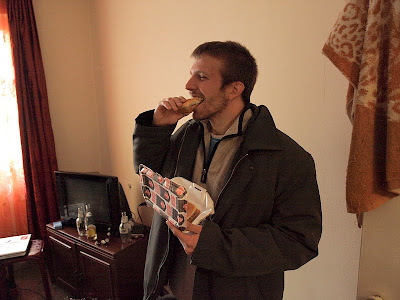
A number of other Peace Corps volunteers (PCVs henceforth) were gathered in an apartment in Almaty, where this photo was taken. This photo captures the unfettered joy that Krystal burgers brought to Michael. It does not, however, begin to explain the mayhem that unfolded once he invited other PCVs to partake in American fast food hamburger goodness. Pro tip: If you come to Kazakhstan, bring at least a sackful of Krystals.
Once the feast ended, we headed to a wonderful coffee shop to feed my still-raging caffeine addiction (a handicap which I gradually overcame through the trip). Then we dropped by Hotel Kazakhstan for internet before meeting a couple of Kazakhs at a bus stop and heading for Medeo.
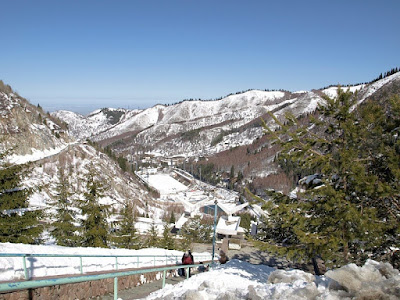
Medeo is an ice rink in the hills around Almaty. It bears the distinction of being the world's highest outdoor skating rink and the future site of the 2011 Asian Winter Games. It is also very expensive to maintain and has thus fallen into disrepair since Kazakh independence in 1991. With the games next year, the rink will reopen for general use.
The stairs in the foreground are the site of an annual Kazakh tradition, the "running of the stairs." Essentially, every year a bunch of manly men get together and race up these 841 ice-covered, super-steep, irregular stairs that run from Medeo to the top of a dam. The winner is crowned king of the mountain and is lauded by all. I did not race up the stairs.

We left Medeo by ski lift to visit the far reaches of the slopes surrounding the rink. Many people came to ski, but we preferred to walk around on the snow and in general look like we had no business on the side of the mountain. The ski lift people took note of this and encouraged us not to do things like 1) slide down the mountain on snow shovels we found, or 2) roll down the mountain in hopes of creating a giant snowball. In the end, we chose to return to the bottom of the slope unharmed.
While waiting for the bus to retun to Almaty proper, I spotted the following creature:
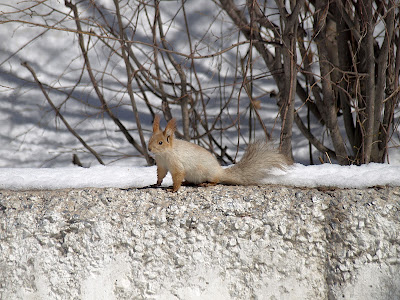
It is a Kazakh squirrel. I have nothing more to say. This photo speaks for itself.
After our Medeo adventure, we met a group of PCVs for doner kebab near the main bazaar in Almaty. Doner kebab in Kazakhstan is different from doner kebab in Turkey, Germany, Greece, or anywhere in Europe for that matter. It starts with a large flour tortilla and doner meat, which is finished with regular doner toppings plus mayonaisse and french fries. The whole concoction is wrapped and pressed (like a panini). It is significantly more odd but similarly delicious as doner kebab anywhere else in the world.
After our lunch we headed to Panfilov Park in the center of Almaty. The park is home to the Ascension Cathedral, a wacky turn-of-the-century Russian Orthodox church patterned after Moscow and Kiev. For trivia buffs, the cathedral is built without a single nail or screw; it is thus the second tallest 100% wooden structure on earth. (I do not know what the tallest is.)
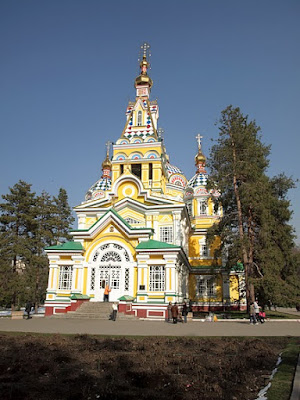
Just when I thought I had seen all that Almaty and Panfilov Park had to offer, Michael took me to see a string of Soviet war memorials. Everything was in Russian, but I think you can get a sense of what they're trying to convey without reading the words.
Soviet WWII memorial:

Soviet WWI memorial:

A giant belt buckle? Nope, another war memorial:
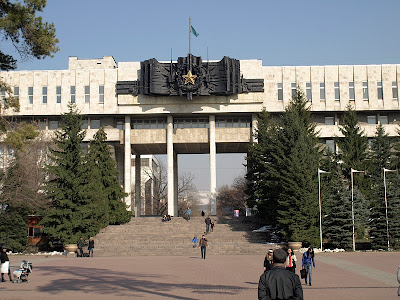
I had never really thought about what people convey with war memorials. These certainly left an impression on me.
By this point in the afternoon, we were exhausted. On the way back to the PCV apartment, we decided to detour past the central mosque of Almaty for a little R&R. The mosque is beautiful, if understated, and was busy with late afternoon visitors when we arrived. We spent a few minutes examining the iconography, listening to chants, and relaxing against the cool walls and columns inside.
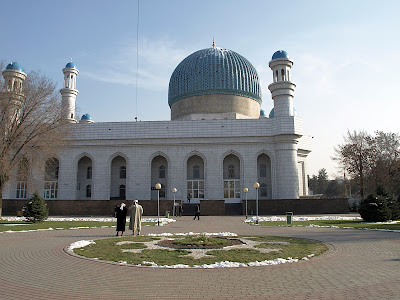
Rejuvenated, we left the mosque only to discover something altogether unexpected and magnificent (thought I would only learn the magnitude of this discovery days later in the small village of Asa). Just a few blocks from the mosque, we encountered the Rahat chocolate factory and the associated factory store. Rahat is something of legend in Kazakhstan- a fine chocolatier producing a variety of solid and filled candy bars and individually wrapped sweets. Rahat candy is sold everywhere, consumed everywhere, loved by all. One day a Kazakh asked me about my tea drinking habits. I responded that I didn't drink much tea in the US. Taken aback, he responded, "Then what do you drink with your candy?"
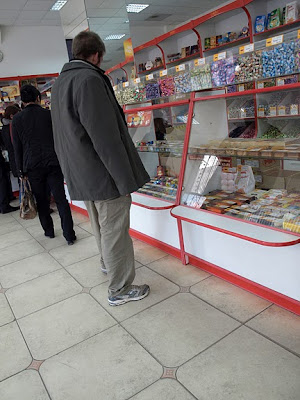
The store was filled with dozens of bins of brightly-colored, individually-wrapped sweets. At the time, this was completely foreign to me. As Michael stood, wide-eyed in front of row after row of candy, I felt a moment of profound cultural incompetence. But, after all, it was only my first day. There was plenty of time to learn.
We left Almaty late Monday evening on a Chinese train bound for Taraz, Michael's fair city. I climbed into my top bunk and was alseep before we even turned off the lights.
- Brad Lindell
Two weeks ago, I had just finished my surgery clerkship. Still reeling from three months of 4:00am mornings and endless menial labor, I boarded a plane (well, four planes actually) bound for the Republic of Kazakhstan. I was bound for uncharted territory, known only to me through this blog, Wikipedia, and Borat.
The journey was 30 hours and 11 time zones. I picked up an Economist in London and some kebab in Istanbul, and before I knew it I was waiting in a disorganized immigration line in the Almaty airport. I had remembered to apply for a visa. Two travelers on my plane had seemingly forgotten; I last saw them sitting forlorn near the door to the runway. After some obligatory cultural misunderstandings and lots of smiling and nodding, I hustled down a hallway and through the baggage line to greet Michael just behind the small army of taxi drivers looking to score a foreign traveler.
Michael and I were roommates for four years at the University of Georgia, and while I saw him periodically since graduation we had been rather out of communication since his Kazakhstan adventure began. I'm sad to say that it had been 18 months since we had seen each other and several since we really had a chance to catch up over the phone. Needless to say, it was great to see him standing there. For one, he rescued me from the ravages of airport taxis.
Visiting Michael was, after all, the entire reason that I decided to spend my last "protected" spring break in Kazakhstan and not Park City or Pensacola. I arrived with one goal in mind- to spend a week with a good friend and try to understand what in the world this Peace Corps experience was all about. Now two weeks after my Kazakh adventure, I feel that we accomplished both goals. I'll be guest blogging for the next six days, chronicling our adventures together and hopefully offering some outsider perspective on Kazakhstan and the Peace Corps experience. I'll also provide photos of key elements of the trip. But before I begin, I want to make the point that Kazakhstan and the Peace Corps are both things that are better experienced first-hand. Rahat candy defies explanation. Yurts must be built to be understood. So, if you have a free week, book a trip to Kazakhstan. Otherwise, just keep reading.
Michael had a few "special requests" for my trip. First, he wanted a new computer. Second, he wanted Krystal hamburgers. The computer was easy enough, but the burgers were quite a logistical problem. They had to arrive fresh, without squishing, and undetected by airport security. And I'm pleased to admit that a mere 34 hours after they were assembled in Nashville, Tennessee, Michael was enjoying two delicious #1 burgers.

A number of other Peace Corps volunteers (PCVs henceforth) were gathered in an apartment in Almaty, where this photo was taken. This photo captures the unfettered joy that Krystal burgers brought to Michael. It does not, however, begin to explain the mayhem that unfolded once he invited other PCVs to partake in American fast food hamburger goodness. Pro tip: If you come to Kazakhstan, bring at least a sackful of Krystals.
Once the feast ended, we headed to a wonderful coffee shop to feed my still-raging caffeine addiction (a handicap which I gradually overcame through the trip). Then we dropped by Hotel Kazakhstan for internet before meeting a couple of Kazakhs at a bus stop and heading for Medeo.

Medeo is an ice rink in the hills around Almaty. It bears the distinction of being the world's highest outdoor skating rink and the future site of the 2011 Asian Winter Games. It is also very expensive to maintain and has thus fallen into disrepair since Kazakh independence in 1991. With the games next year, the rink will reopen for general use.
The stairs in the foreground are the site of an annual Kazakh tradition, the "running of the stairs." Essentially, every year a bunch of manly men get together and race up these 841 ice-covered, super-steep, irregular stairs that run from Medeo to the top of a dam. The winner is crowned king of the mountain and is lauded by all. I did not race up the stairs.

We left Medeo by ski lift to visit the far reaches of the slopes surrounding the rink. Many people came to ski, but we preferred to walk around on the snow and in general look like we had no business on the side of the mountain. The ski lift people took note of this and encouraged us not to do things like 1) slide down the mountain on snow shovels we found, or 2) roll down the mountain in hopes of creating a giant snowball. In the end, we chose to return to the bottom of the slope unharmed.
While waiting for the bus to retun to Almaty proper, I spotted the following creature:

It is a Kazakh squirrel. I have nothing more to say. This photo speaks for itself.
After our Medeo adventure, we met a group of PCVs for doner kebab near the main bazaar in Almaty. Doner kebab in Kazakhstan is different from doner kebab in Turkey, Germany, Greece, or anywhere in Europe for that matter. It starts with a large flour tortilla and doner meat, which is finished with regular doner toppings plus mayonaisse and french fries. The whole concoction is wrapped and pressed (like a panini). It is significantly more odd but similarly delicious as doner kebab anywhere else in the world.
After our lunch we headed to Panfilov Park in the center of Almaty. The park is home to the Ascension Cathedral, a wacky turn-of-the-century Russian Orthodox church patterned after Moscow and Kiev. For trivia buffs, the cathedral is built without a single nail or screw; it is thus the second tallest 100% wooden structure on earth. (I do not know what the tallest is.)

Just when I thought I had seen all that Almaty and Panfilov Park had to offer, Michael took me to see a string of Soviet war memorials. Everything was in Russian, but I think you can get a sense of what they're trying to convey without reading the words.
Soviet WWII memorial:

Soviet WWI memorial:

A giant belt buckle? Nope, another war memorial:

I had never really thought about what people convey with war memorials. These certainly left an impression on me.
By this point in the afternoon, we were exhausted. On the way back to the PCV apartment, we decided to detour past the central mosque of Almaty for a little R&R. The mosque is beautiful, if understated, and was busy with late afternoon visitors when we arrived. We spent a few minutes examining the iconography, listening to chants, and relaxing against the cool walls and columns inside.

Rejuvenated, we left the mosque only to discover something altogether unexpected and magnificent (thought I would only learn the magnitude of this discovery days later in the small village of Asa). Just a few blocks from the mosque, we encountered the Rahat chocolate factory and the associated factory store. Rahat is something of legend in Kazakhstan- a fine chocolatier producing a variety of solid and filled candy bars and individually wrapped sweets. Rahat candy is sold everywhere, consumed everywhere, loved by all. One day a Kazakh asked me about my tea drinking habits. I responded that I didn't drink much tea in the US. Taken aback, he responded, "Then what do you drink with your candy?"

The store was filled with dozens of bins of brightly-colored, individually-wrapped sweets. At the time, this was completely foreign to me. As Michael stood, wide-eyed in front of row after row of candy, I felt a moment of profound cultural incompetence. But, after all, it was only my first day. There was plenty of time to learn.
We left Almaty late Monday evening on a Chinese train bound for Taraz, Michael's fair city. I climbed into my top bunk and was alseep before we even turned off the lights.
- Brad Lindell
Subscribe to:
Posts (Atom)

 Posts
Posts